
Efficient Swarf Processing Supports Continuous Production at Hyde Group
Bespoke swarf management solution helps improve machining efficiency, reduce handling requirements and support more sustainable manufacturing
Hyde Group continues to invest in technologies that improve manufacturing efficiency and support its commitment to more sustainable production. As part of this ongoing investment, the Group worked with us to develop a bespoke solution for managing the aluminium swarf that seven machining centres produce at its manufacturing facility.
The project addressed a key challenge: machining one of Hyde Group's largest parts on a DMG Mori machining centre. The component takes around two weeks to machine, but the process was previously interrupted regularly to allow operators to clear the swarf from the machine.
For such a long production cycle, efficient swarf management is essential to maintaining machine utilisation and keeping production moving.
A bespoke approach to swarf processing
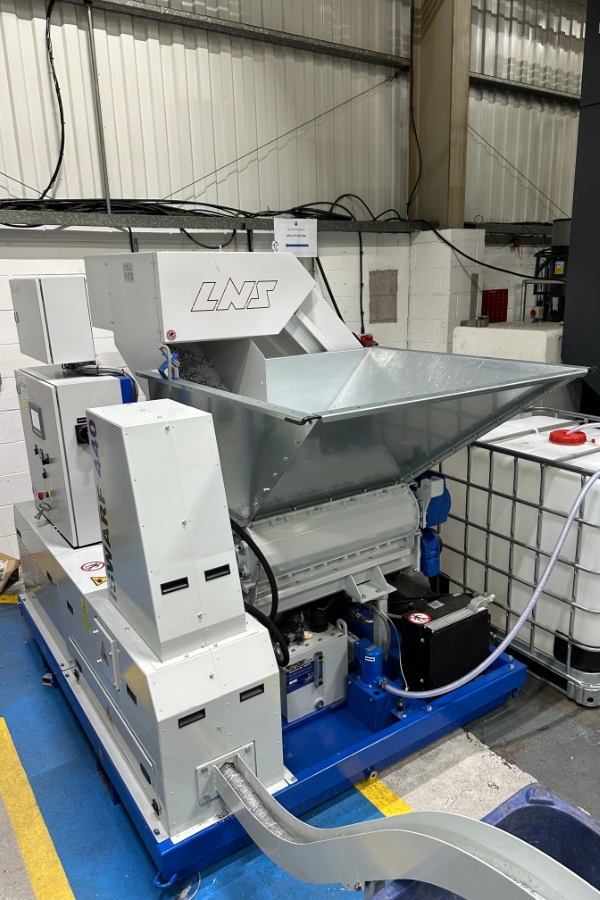
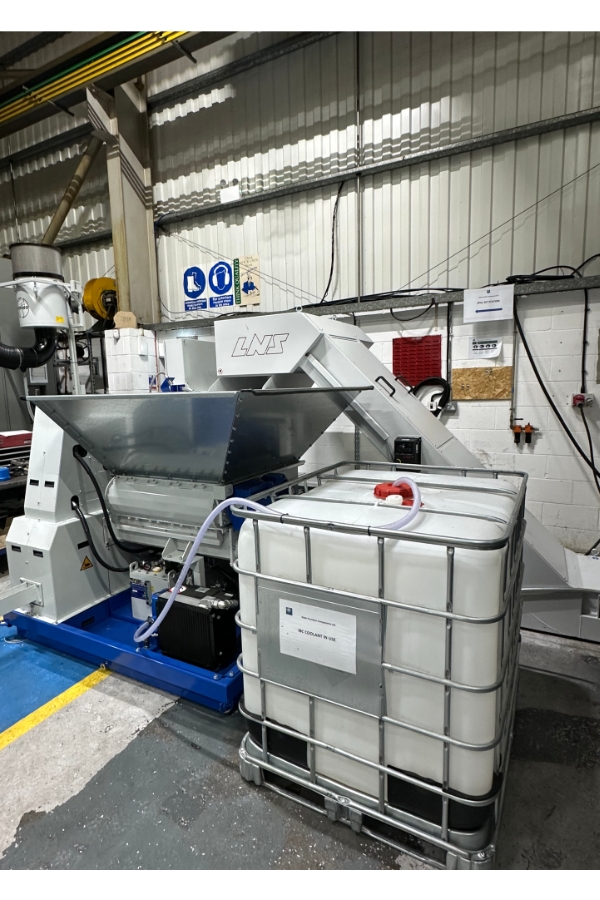
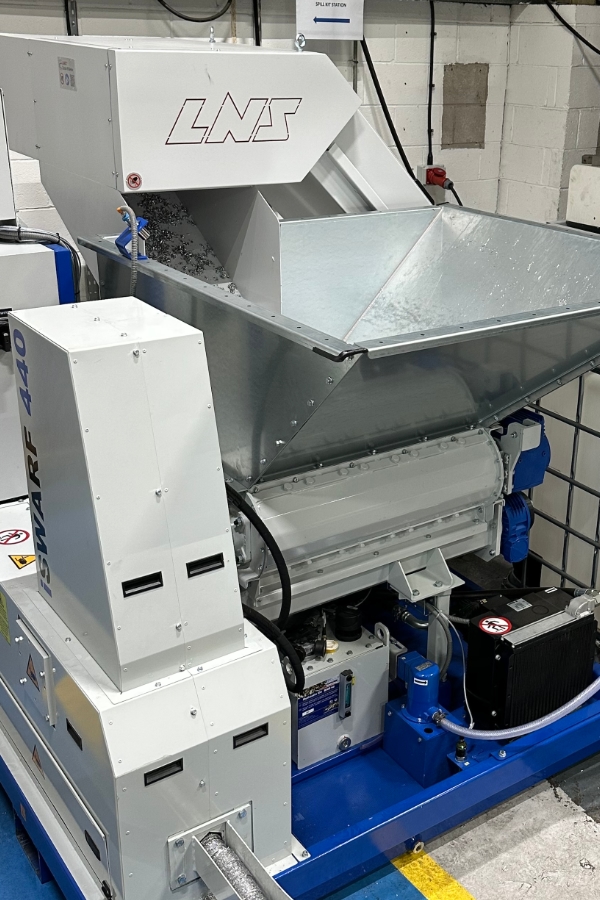
The solution combines an iSwarf 440 briquetting machine, an LNS conveyor and a bespoke hopper that we designed specifically around Hyde Group's requirements.
The LNS conveyor feeds aluminium swarf directly from the DMG Mori machining centre into the iSwarf 440. The briquetting machine can process up to 150 kg of Hyde Group's specific aluminium swarf per hour, producing compact briquettes that are easier to handle, store and transport.
The bespoke hopper provides additional flexibility. While one side receives swarf directly from the DMG Mori via the conveyor, the opposite side can be loaded by forklift from a swarf bin. This allows the system to operate both as a dedicated solution for the DMG Mori and as a centralised system capable of processing swarf from the facility's other six machining centres.
This flexibility means swarf can be processed close to where it is generated, without requiring a completely separate system for each machine.
Supporting uninterrupted machining
One of the key benefits of the installation is the ability to manage swarf continuously alongside the machining process.
Previously, the build-up of swarf meant that the DMG Mori machining cycle had to be regularly interrupted by operators to remove the swarf. With the new system, swarf is continuously conveyed away from the machine and processed into briquettes.
As a result, Hyde Group can now machine the large component continuously over its two-week production cycle, without the same requirement for regular swarf clearance.
This helps Hyde Group make better use of available machine capacity while reducing the time and resources associated with handling swarf.
The system also supports overnight running, as the need for operators to empty the swarf bins during production is significantly reduced.
Recovering coolant as part of the process
The system also incorporates coolant recovery.
During briquetting, the system separates coolant from the aluminium swarf and collects it in an IBC. It can then be pumped directly back to the DMG Mori machine.
This reduces the frequency with which the machine needs to be topped up with coolant, while making better use of a resource that would otherwise leave the machining process with the swarf.
More efficient waste handling
Efficient management of metal waste is an important part of overall production performance. By processing swarf directly where it is generated, the system reduces the need for repeated collection and movement of loose swarf around the factory.
The resulting briquettes are more compact than loose swarf, making subsequent storage, handling and transport more straightforward.
For Hyde Group, the project provides a more efficient way of managing aluminium swarf while supporting the wider objective of maximising machine utilisation and improving the flow of materials across the factory.
A solution designed around the process
Rather than taking a standard approach, we developed the system around Hyde Group's specific production requirements.
The iSwarf 440, LNS conveyor and bespoke hopper combined, enable the system to handle swarf from a single machining centre directly, while also providing the flexibility to process material from multiple machines.
The result is a swarf management system that works alongside the machining process — helping the machines run for longer, reducing manual intervention and making the handling of metal waste more efficient.
For manufacturers looking to improve production efficiency, managing waste metal effectively can be just as important as optimising the machining process itself.